How do you know whether you’re successful in your cloud journey and your digital transformation?
It’s not just running the application without downtime but it’s also about how much you spend ($) in the cloud.
The CFO must be happy with our spending otherwise we need to take a look to optimize the costs.
Just moving to the cloud will have some benefits—better security and availability, for example. But that probably isn’t the only reason you’re moving to the cloud. Whatever your reason is gaining access to machine learning, better analytics, edge computing, or whatever—it’s probably a reason that requires you to actively build or modernize. At the same time, if you want to reduce costs, you have to work to reduce costs. Then only we get the celebrating results.

It’s time to discuss the strategy rather than elaborating on the problem of more spending($) in the cloud. It requires a comprehensive approach and understanding of the various opportunities for cost optimization. Here comes Cloudaliv and our five pillars of Cost Optimization to reduce your expenditure.
Five pillars of Cost Optimization
Savings Plans are a flexible pricing model offering lower prices compared to On-Demand pricing, in exchange for a specific usage commitment (measured in $/hour) for a one or three-year period. AWS offers three types of Savings Plans – Compute Savings Plans, EC2 Instance Savings Plans, and Amazon SageMaker Savings Plans. You can easily sign up for 1- or 3-year term Savings Plans in AWS Cost Explorer and manage your plans by taking advantage of recommendations, performance reporting, and budget alerts. AWS Organizations helps you quickly scale your environment by allowing you to programmatically create new AWS accounts. Centralized organizational units will give a greater volume of discounts.
2. Automation :
One of the benefits of the cloud is to stop guessing capacity, which means, scaling up and down as per the requirement. This has to be done by automation and a proper tagging strategy to spin down the idle resources. Tools like ParkMyCloud, AWS Instance Scheduler, Azure Automation, and Google Cloud Scheduler can help you manage the entire automation of the process.
3. Right Fit :
To determine the right fit one has to determine the size. To determine the size one has to use different tools to calculate performance and capacity at present and in the future. Everything must be tailored as per the requirement from beginning to end. This is an ongoing activity as businesses attract customers differently in different seasons. For this, we have to use the right policies and tag the resources accordingly to terminate them after use and consider the resources account that we get through Savings Plans.
4. Hardware Family :
It’s a herculean task to upgrade all the hardware to a new family whenever they are available. But we provide you with recommendations through our optimization service offering.
5. Determining Under-Utilized Resources :
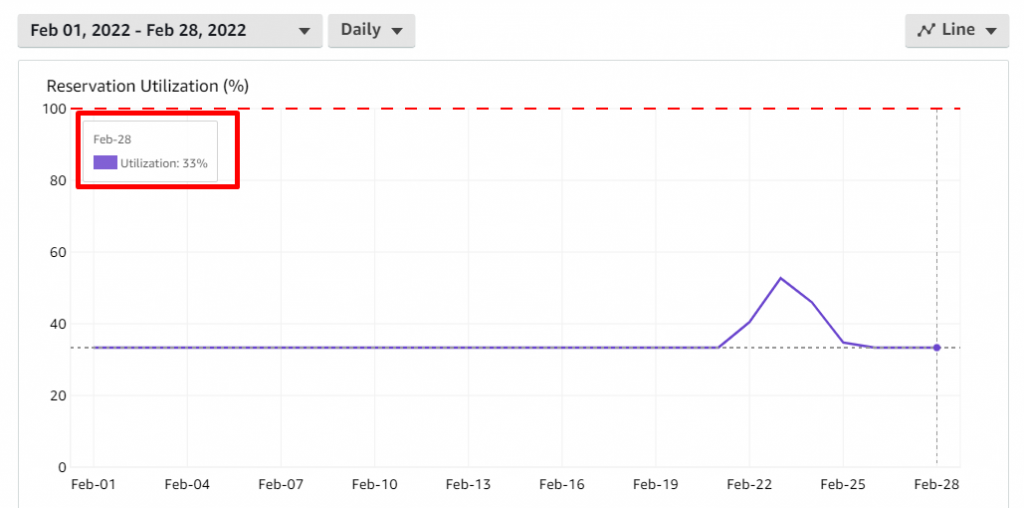
The above image shows the underutilization of RI. This is just an example. This causes overspending in the cloud – for at least a year. Purchasing Savings Plans and RI’s without proper estimation is going to cost you so much by keeping underutilization resources with you.
There may be many idle resources when the business is giving so many services. Tagging strategy will be helpful. Organizational unit marks for review and/or removal.
Note: Cost Optimization in the Cloud is a continuous process. It’s not a one-time activity.
Cloudaliv offers a Cloud Cost Optimization service that can help guide you through this process. Start your cloud cost optimization plan with our proven methodology.